Johan Stracké
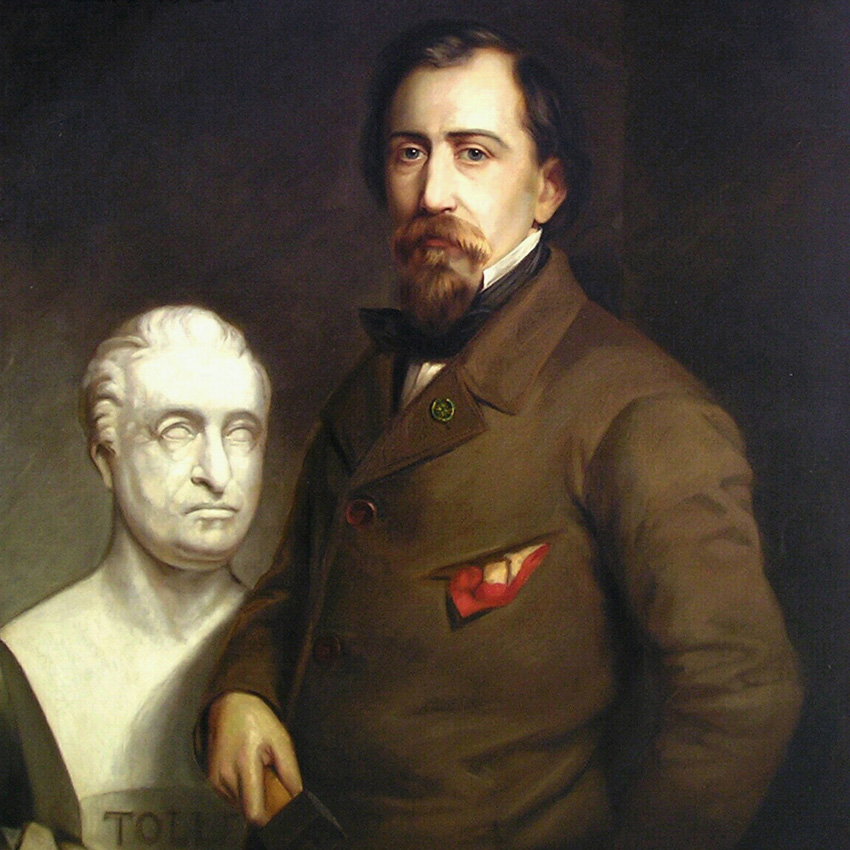
Johan (Jean) Theodore Stracké, was the son of sculptor Ignatius Johannes Stracké and Ursula de Ruijter. He was born in Dorsten, Germany in 1817 and moved, with his parents, to the city of Arnhem in the Netherlands in 1842.
Johan became a student of William Geefs in Brussels before spending some time in England, Germany and France. He then settled in Rotterdam in 1848 where he was appointed professor at Rotterdam Academy.
In 1854, Johan married Leontine Virginie Epiphanie Marchal (1823-1891). Her father, François Joseph Ferdinand Marchal (1780-1858), was Belgian, descending from Prince Charles of Lorraine. Her mother, Isabelle Euphémie Victoire DIEZ (1796-1864) also Belgian, was born in Antwerp. They produced a daughter Epiphania (who married Petrus Arendzen) and three sons, Carolus, Franciscus and Leo. The latter two were both sculptors.
After 1860, Johan moved back and forth between Holland and Germany before becoming director of Ecole des Beaux-Arts at ‘s-Hertogenbosch (Herzogenbusch) from 1876 to 1891. He died in Cologne, Germany in 1891.
Both the Rijksmuseum and Rotterdam Museum exhibit a number of works by Johan (and other family members). I have uploaded several images of Stracké sculpture to this website (click the “Works” link in the header).
The portrait above, by the Dutch artist, Sybrand Altmann, is one of two almost identical versions. According to the newspaper De Telegraaf, published November 13, 1894, one painting was donated by Franciscus Leonardus Stracké to the Rijksmuseum, after his father’s death. In its report, De Telegraaf referred to Johan Stracké as the ‘King’s sculptor.’
The second painting, featured here, ended up in a collection in England. It is possible that it was owned by Johan’s daughter, Epiphania, and that it was sold, along with many other items, in a clearance sale from the family home in Quex Road, Hampstead, after the death of Leo in 1963, who was the last remaining Arendzen to live there.
This is no more than speculation but it would explain why the painting was in England. The portrait eventually came up for sale at the London gallery of Miles Barton, who was kind enough to sell it to me for a very reasonable sum.